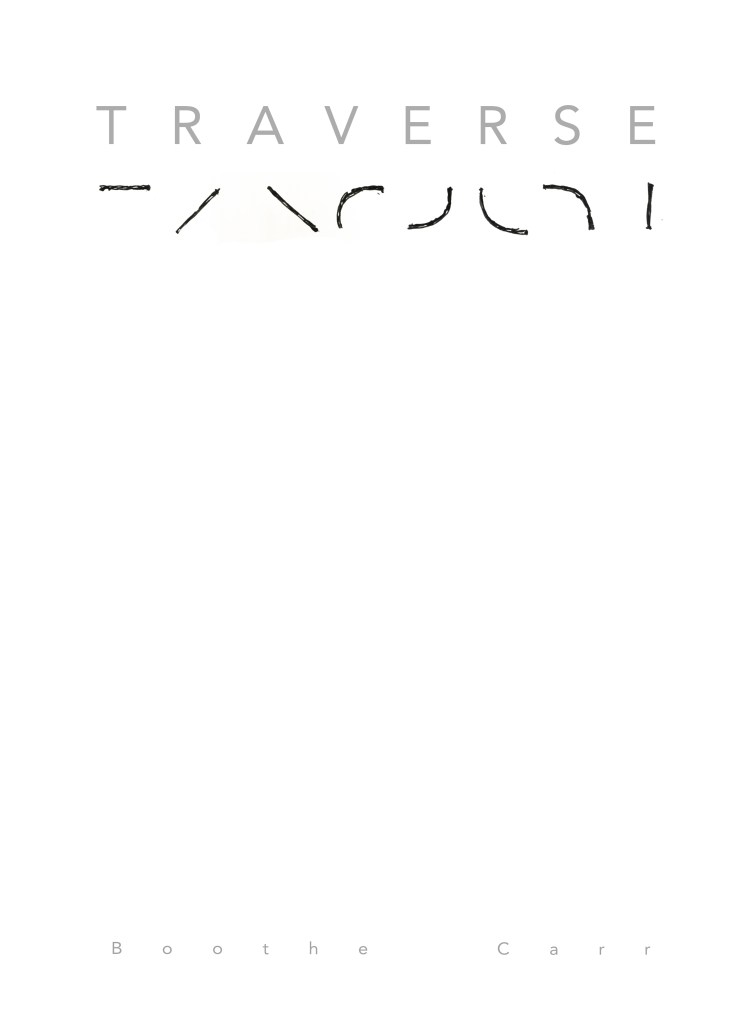
Traverse: a book of image and text by Laurence Carr and Power Boothe, Lightwood Press, 2022. ($40.00/ contact Laurence Carr for information and author’s discount.
Reviews:
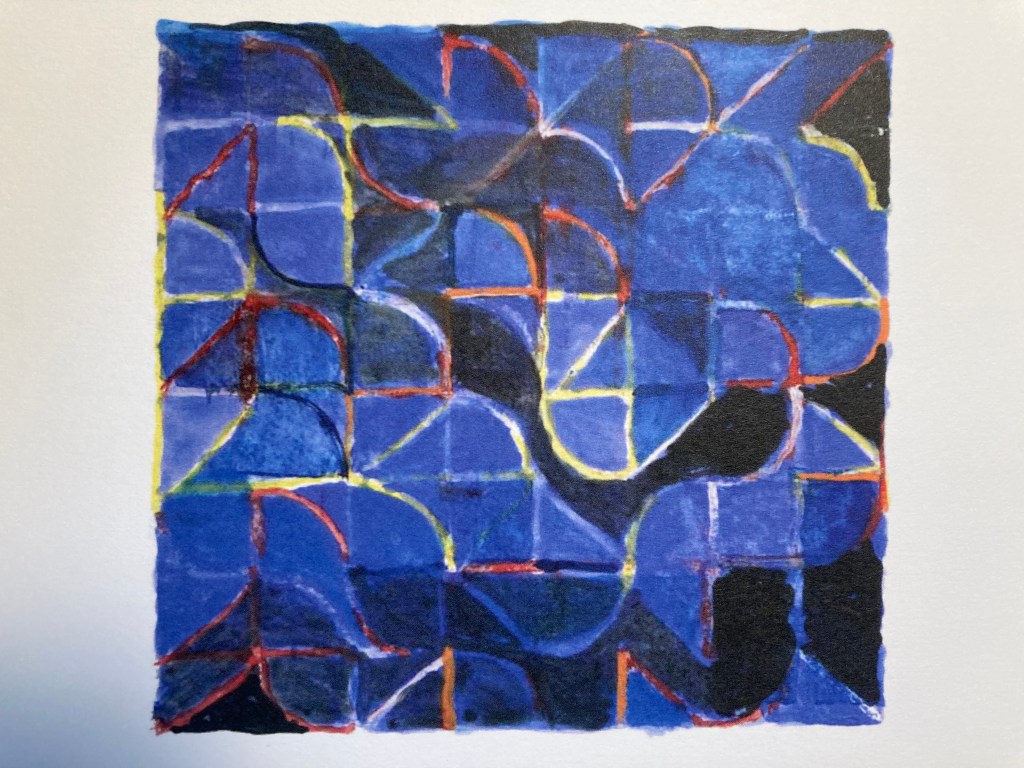
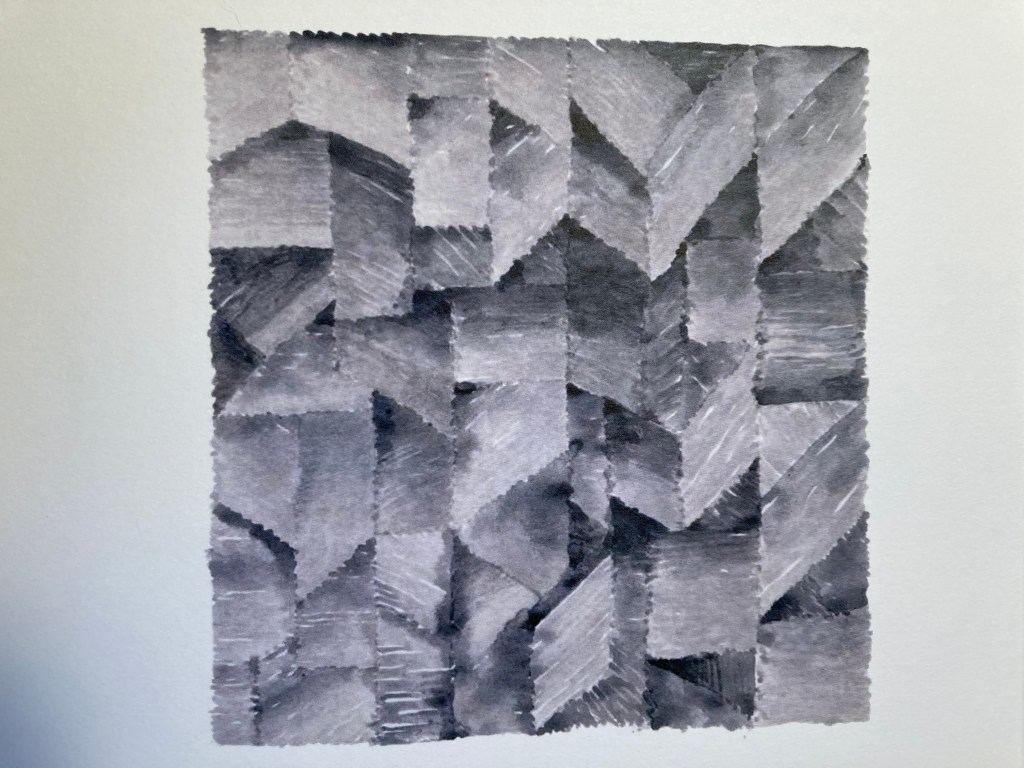
In Traverse, Boothe and Carr are each in accordance with his own talent, serious about Playfulness. If you are in need of intellectual and graphic play, sit down with these pages and enjoy their singular performances. Each of the pages faces off with on the right, Boothe’s consistently 5.25 x 5.25 inch squares containing shapes that repeat, morph or fugue into other shapes in close relationship. I see them as jazz-lines with empty mind-space completing their kinship.
On the left-facing page, Carr, with unrestricted, sagacious imagination, tells us his own riff, often using quasi-Physics, Geometry or Biology. You don’t have to agree. That’s not the point. He is not trying to un-abstract the images. In Carr’s words, “It’s as though each individual scroll has been discovered in some future time ‘long, long ago’, revealing a culture with an intelligence and visual data of its own.” The scrolls become their natural worlds or in Carr’s words, “eye universe”.
The book has a spare-clean feel to it thanks to the designer, James Sarfati.
-Gregory Abels, Where to Begin and Never Something Else
////////
Power’s work is wonderful… it seems musical to me and reminds me so much of the music of Bach… the way a germ is spun out into an entire composition.
Thomas Wharton, Artist and Writer
////////
Laurence Carr’s and Power Boothe’s volume traverses genres in both text and image in challenging and exciting ways, spurring imaginative journeys and illumination. Carr’s evocative and original poems, moments of contemplation that explore mythic, philosophical and scientific realities, pair beautifully with Boothe’s striking and diverse drawings. An immersive experience, this interplay of word and image provides hours of revelation and enrichment.
- Jan Zlotnik Schmidt, Over the Moon . . .Gone: The Vanishing Act of Bess Houdini
////////
Each morning I open Traverse to a random page set to awaken my mind and spirit. Each combination of visual and narrative organizes my day for questioning the next steps not only for each hour and activity but the why.
- Jess Nadelman, micro-fiction author: The Aerialist and Slow to a Trickle
/////
The book is pleasant in the hand: a stolid white square, smooth to my touch. It
invites random opening and browsing, sometimes to gaze at an image, sometimes
to follow lines of text.
I am reminded of mysteries of past millennia revealed, such as those seen in
Werner Herzog’s Cave of Forgotten Dreams.
My eye and mental space are soothed by the regularity of form: images in an
8-block pattern, text mostly of eight lines. Is there a sedative quality to the number 8?
It may be the recurrent geometrics of the pages that reminds me of Agnes Martin,
whose work—even in distant recall—puts me in a place of receptive quietude.
And Traverse carries all sort of echoes of the I Ching.
-William G. Burnett, writer, Lightwood magazine
////////
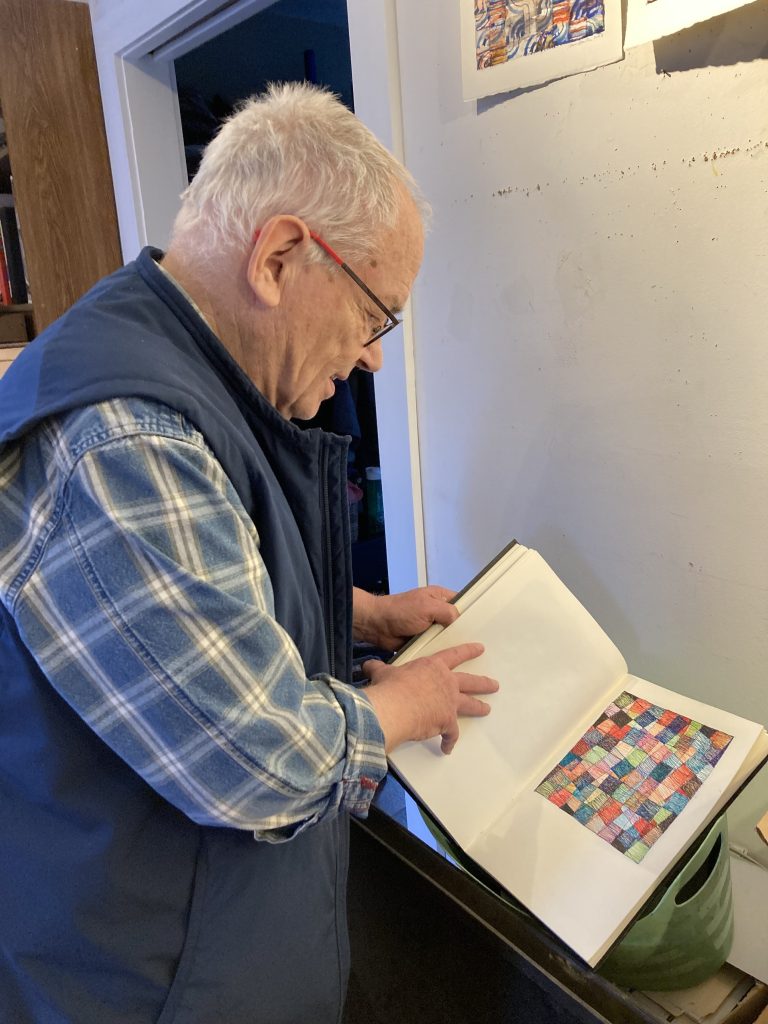
Power Boothe, artist
Traverse, by Power Boothe and Laurence Carr [Highland, NY: Lightwood Press, 2022] 130 pages.
This handsomely produced book, designed by James Sarfati, is a riddle in itself. In composition, it is simple. A short text verso (Carr) faces an artwork recto (Boothe). The artwork presents a set of symbols in the form of runes, or rune-like lines, that relate to the words. How? We can assume that the coming together of poet and artist in an act of creative collaboration, is of great good fortune for us readers. Carr, a writer of impressive breadth, and Boothe, visual artist with an exemplary corpus, bring their talents to a fine point in Traverse. We are offered a sacred alphabet that conveys a force of refinement and purification to the human condition.
But the sacred never appears undisguised. So we must ask, what is this book about? A few answers present themselves:
- A catalog of the canals on Mars,
- Glyphs of possible human postures,
- Biopsy results for a feline kidney,
- Uncollected sayings of a thirteenth century Silesian mystic,
- An auto mechanic’s notes on a blown carburetor.
A more serious look, however, seizes on the author and artist’s creative intent. It is a book of correspondences. A correspondence, in the occult sense of the word, tries to link an aspect of the visible world to one of the invisible. For instance, the pattern of a walnut meat to that of the human brain, from which to infer that walnuts are good ‘brain food.’ The effort is to take the formless and subject it to two reductions (epoches), one visual, one textual. The purpose is to relate the otherwise unrelated modalities to a broader human understanding; for instance, as Carr writes, ‘the maker takes the formless, the mindless and puts/it on the potter’s wheel forming . . . all that can be.’ [78] In this way, the microcosm or human is reconciled with the macrocosm or universal. The result is a kind of analectic, borrowing a form from certain Eastern tradition that purports to guide seekers on a way to self-knowledge. Sayings are brief, pithy observations of ordinary as well as improbable things that produce a sudden illumination in their readers.
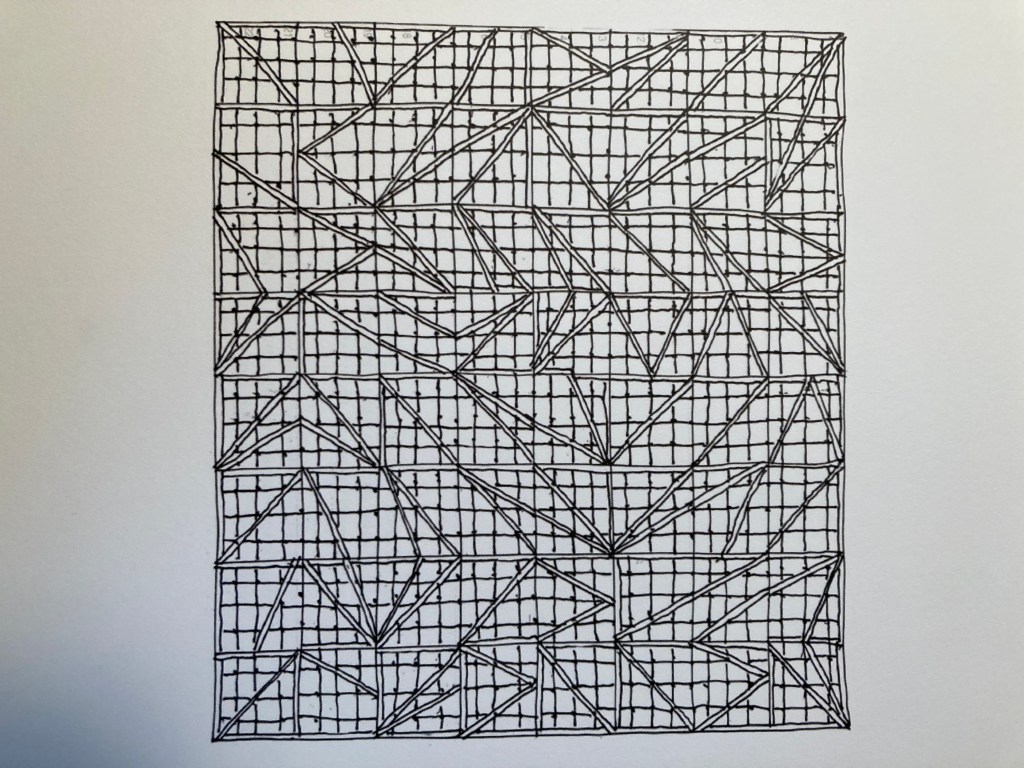
This is a huge and hugely invaluable project. Ultimately it tries to construct something like the I Ching, which is popularly known as a book of prophecy, but in fact presents a way to liberation through the present moment in its cosmic dimension. It is a book of initiation, to be grasped in that role only by those who seek it. ‘Once initiated, the life traveler/journeys in an everland of awareness/of past, present, and future.’ [124] The initiation draws on points of correspondence—text with artwork—to bring together creator and creature: ‘creation/creator and the reader/viewer/share . . . what was first/depicted during the imprints of the/First Journey.’ [126] Simply said.
But I jump too quickly to the big picture. One needs to savor the import of small steps along the way. For instance, early on, Carr and Boothe point to the correspondence between the dream state and wakefulness, offering us a ‘dream time sequence,’ reminiscent of the Australian aboriginal dream time. [4] Later, kinship relations (a la Levi-Strauss) are correlated with totemic masks [30]. The melodic scale (‘heard throughout the forest’) is juxtaposed with a system of musical notation [44]. It would seem that the intention of this intrigue of a book is toward a wider, but contradictory vision of duality: ‘Guests, after drinking the ucasa/juice, were taken to a “vision/chamber”. . .’ [68] There, if granted a vision in response to the quest, one is thereby informed about other miraculous transformations—for that is the purpose of correspondence, to change one for the other, the finer for the coarser. One has the power then to pass over the mundane to the spiritual and back again [70], from the historical to the eschatological [105], even from the created to the creator [126].
The main point of the extended exercise appears to be a re-instatement of lost knowledge, shamanic or alchemical in nature, that once gave humans a claim to be participants in an evolving cosmos. Once in a golden age, such information allowed humanity a degree of freedom that is unimaginable in today’s war-begotten world. ‘Spirit messages were etched on small/stones, chipped in shaped squares. . .’ [122] Author and artist envision a world resuscitated by ‘the connection between feeding the living/and the dead, as well as those not yet conceived/has been well established.’ [114]
We are among those ‘not yet conceived’ in that mystic time. These pairs of runes are meant to transport us, to support our lives as fully human members of both worlds, interacting with divinities and animal spirits alike. This diptych is an exciting project for which there is good reason to take up Carr and Boothe’s provocation, and to study their text.
David Appelbaum (author, editor, publisher and founder of Codhill Press)


Leave a Reply